Sunday, February 15, 2015
Thursday, January 29, 2015
Uttara Ranganatha Swamy Temple
Uttrara Ranganatha Swamy Temple
Main Entrance
Lord Ranganatha
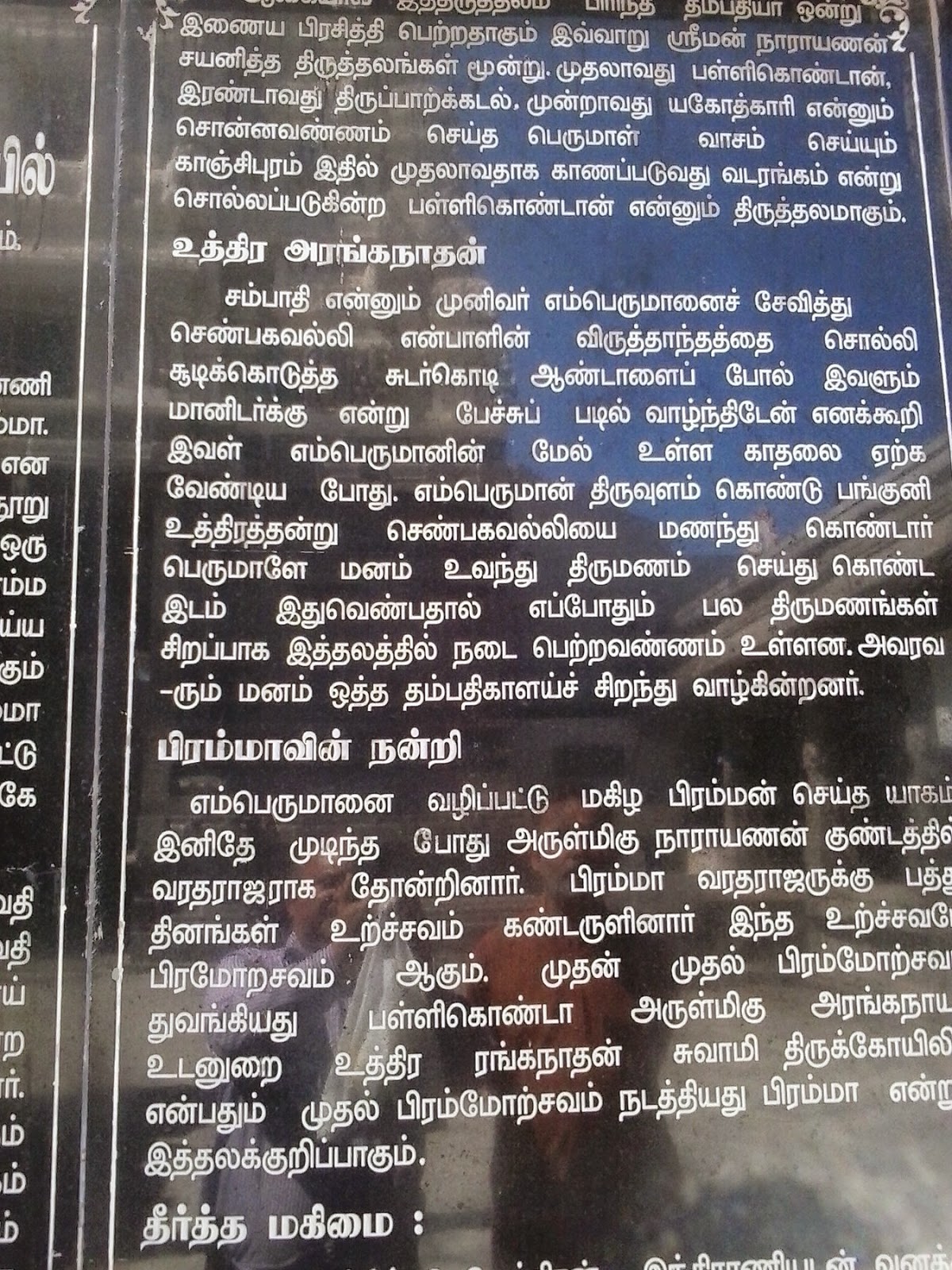
The Uthara Ranganatha Swamy is an ancient temple located on the banks of the river Palar in Pallikonda just 1 kms from the Junction towards Gudiyattam and 23 km from Vellore on vellore - Bangalore highway.Pallikonda is just 24 Kms from Ambur.Situvated on the Banks of River Palar and other 2 more Rivers invisible now we can see only Palar river bed.It is said that it holds 1000 old years of History,Here Lord Ranganatha in the temple is made of Salagrama so many Miracles have happened and retold by many there.This temple Mahime (Multi-Power) is mentioned in Brahmanda Purana.
Name Plate
another view of the Lord
There are Nine shrines inside the temple complex including that of Uthara Ranganatha, Ranganayaki Devi, Rama, Navaneetha Krishna, Garuda, Andal, Anjaneya, and Manavala Mamunivar and has been recently renovated and Main Gopuram has a Majestic look from Far off distance.Devotees can perform tulasi Archana to Lord Ranganatha and Kumkumacharane to Devi Ranganayaki.
Andal Sannathi
Festivals conducted and celebrated during the year are---Thai Giri Pradakshinam in January-February, Masi float festival in February-March and Panguni Uthiram in March-April are the festivals.Chithirai Brahmmotsavam in April-May, Vaikasi Visakam Garuda Sevai in May-June, Aani Jeshta Tirumanjanam in June-July, Aadi Fridays Tiruvadipooram in July-August, Sri Krishna Jayanthi, Purattasi Navarathri in September-October, Tirukarthikai in November -December,Vaikunta Ekadasi in December.
Mass Marriages are conducted here regularly.
Gopuram
Navaneetha Krishna Sannathi
According to the Sthala History, there lived a king called Amba Raja who was ruling this part of the country called Thiruvedhimangalam (today’s Pallikonda). He has been highly victorious and was enjoying all the worldly pleasures as a king. Having fed up with materialistic life, he one day realized that the purpose of his birth is only to get the Dharshan of Sri Maha Vishnu. He started
worshipping Maha Vishnu for years together and was eagerly waiting to have his Dharshan. Years rolled by. But there was no sign of God appearing to him. He got frustrated and attempted suicide. While he was trying to commit suicide, a heavenly voice from the sky told him to be patient and to continue his prayers so that he will soon get the dharshan of God.
inside view of the Gopuram
Sacred Badari Tree
The king became happy and continued his worships. During the same time a debate came up in the Lord Brahma’s court hall (Brahma Sabha). It was about, who is the greatest among Durga (for courage), Lakshmi (for wealth) and Saraswathi (for wisdom). After a long debate, Lord Brahma gave a conclusion that Lakshmi is the supreme. Hearing this, Saraswathi got angry and walked away, leaving Brahma. Brahma tried convincing her and failed. Brahma went and prayed Lord Vishnu asking for a solution as he cannot live without Saraswathi. Lord Vishnu assured that he
will try to bring down her anger.
Sri Rama Temple
Saraswathi took the form of a river named Vegavathi and started flowing through. Trying to stop her, Lord Vishnu lied in a reclining pose (Ranganatha) at Thiruvedhimangalam (Pallikonda). Knowing this, Saraswathi bypassed him adjacent to his feet and moved further. Lord Vishnu again went to another place along her route and stayed again in a reclining posture. This time Saraswathi cleverly bypassed him again above his head and went on.
Temple History 1
Temple History 2
Temple History 3
Lord Vishnu decided to stop her some how and went and rested in another place again in the same posture obstructing her way. This time Saraswathi had to face Lord Vishnu obstructing her and was not able to move further beyond Him, as he is the supreme. Saraswathi’s anger subsided and she went into the earth at this third place where Lord Ranganatha reclined. After this event, as Amba Raja was worshipping eagerly to have His Dharshan, Lord Vishnu came back to Pallikonda and
gave Dharshan to Amba Raja.
Pic 1
Pic 2
Pic 3
The king asked for a boon that the God should settle here and give Dharshan to everyone visiting this place. As the God settled here during his act of uniting Brahma and Saraswathi, the king prayed that He should grant boon for unmarried people and the separated couples visiting here. Lord Ranganathar agreed to it and granted his wish. Even today, it is said that unmarried men or women who worship Lord Ranganathar here, get married soon. Also the couples, who have quarrels or separation in married life, get united upon worshiping Lord Ranganatha here.
Pic 4
Pic 5
Pic 6
The first place where Lord Ranganatha tried stopping Saraswathi who was flowing as river Vegavathi (today’s Palar) is today’s Pallikonda. Here Palar flows at the down side of the Lord’s feet. The second place where he attempted to stop her is called Thiruppaarkadal now, near Kaverippaakkam on the Bangalore highway. Here there is a Lord Ranganatha temple where
Palar river passes on the head side of the lord.
Pic 7
Pic 8
Pic 9
The third place where he finally stopped the river is called Thiruvekka, which is in Kanchipuram. There’s another Lord Ranganathar temple here again. In all the three places Lord Vishnu is seen in the reclined posture as Lord Ranganatha. In Pallikonda Lord, Ranganatha gives Dharshan with Sri Ranganayaki on the banks of the river Vegavathi (today’s Palar). Also seen are Sri Devi and Bhu Devi. This temple is said to have built by Vijayanagara Kings during 5th Century. Other deities of the temple like Lord Rama, Garuda, etc., have been built at various stages by many kings who ruled here. But Lord Ranganatha is said to be the Aadhi Moola which was excavated from the banks of the river and Re-built by Vijayanagara Kings.
One Must Visit this Place to get Lord's Blessings with Good Health, Success and Happiness in Life.
------------- Hari Om -------------
Lord Ranganatha
The Uthara Ranganatha Swamy is an ancient temple located on the banks of the river Palar in Pallikonda just 1 kms from the Junction towards Gudiyattam and 23 km from Vellore on vellore - Bangalore highway.Pallikonda is just 24 Kms from Ambur.Situvated on the Banks of River Palar and other 2 more Rivers invisible now we can see only Palar river bed.It is said that it holds 1000 old years of History,Here Lord Ranganatha in the temple is made of Salagrama so many Miracles have happened and retold by many there.This temple Mahime (Multi-Power) is mentioned in Brahmanda Purana.
Name Plate
another view of the Lord
There are Nine shrines inside the temple complex including that of Uthara Ranganatha, Ranganayaki Devi, Rama, Navaneetha Krishna, Garuda, Andal, Anjaneya, and Manavala Mamunivar and has been recently renovated and Main Gopuram has a Majestic look from Far off distance.Devotees can perform tulasi Archana to Lord Ranganatha and Kumkumacharane to Devi Ranganayaki.
Anjaneya Swamy Sannathi
Andal Sannathi
Festivals conducted and celebrated during the year are---Thai Giri Pradakshinam in January-February, Masi float festival in February-March and Panguni Uthiram in March-April are the festivals.Chithirai Brahmmotsavam in April-May, Vaikasi Visakam Garuda Sevai in May-June, Aani Jeshta Tirumanjanam in June-July, Aadi Fridays Tiruvadipooram in July-August, Sri Krishna Jayanthi, Purattasi Navarathri in September-October, Tirukarthikai in November -December,Vaikunta Ekadasi in December.
Mass Marriages are conducted here regularly.
Navaneetha Krishna Sannathi
According to the Sthala History, there lived a king called Amba Raja who was ruling this part of the country called Thiruvedhimangalam (today’s Pallikonda). He has been highly victorious and was enjoying all the worldly pleasures as a king. Having fed up with materialistic life, he one day realized that the purpose of his birth is only to get the Dharshan of Sri Maha Vishnu. He started
worshipping Maha Vishnu for years together and was eagerly waiting to have his Dharshan. Years rolled by. But there was no sign of God appearing to him. He got frustrated and attempted suicide. While he was trying to commit suicide, a heavenly voice from the sky told him to be patient and to continue his prayers so that he will soon get the dharshan of God.
inside view of the Gopuram
Sacred Badari Tree
The king became happy and continued his worships. During the same time a debate came up in the Lord Brahma’s court hall (Brahma Sabha). It was about, who is the greatest among Durga (for courage), Lakshmi (for wealth) and Saraswathi (for wisdom). After a long debate, Lord Brahma gave a conclusion that Lakshmi is the supreme. Hearing this, Saraswathi got angry and walked away, leaving Brahma. Brahma tried convincing her and failed. Brahma went and prayed Lord Vishnu asking for a solution as he cannot live without Saraswathi. Lord Vishnu assured that he
will try to bring down her anger.
Sri Rama Temple
Saraswathi took the form of a river named Vegavathi and started flowing through. Trying to stop her, Lord Vishnu lied in a reclining pose (Ranganatha) at Thiruvedhimangalam (Pallikonda). Knowing this, Saraswathi bypassed him adjacent to his feet and moved further. Lord Vishnu again went to another place along her route and stayed again in a reclining posture. This time Saraswathi cleverly bypassed him again above his head and went on.
Temple History 1
Temple History 2
Temple History 3
Lord Vishnu decided to stop her some how and went and rested in another place again in the same posture obstructing her way. This time Saraswathi had to face Lord Vishnu obstructing her and was not able to move further beyond Him, as he is the supreme. Saraswathi’s anger subsided and she went into the earth at this third place where Lord Ranganatha reclined. After this event, as Amba Raja was worshipping eagerly to have His Dharshan, Lord Vishnu came back to Pallikonda and
gave Dharshan to Amba Raja.
Pic 1
Pic 2
Pic 3
The king asked for a boon that the God should settle here and give Dharshan to everyone visiting this place. As the God settled here during his act of uniting Brahma and Saraswathi, the king prayed that He should grant boon for unmarried people and the separated couples visiting here. Lord Ranganathar agreed to it and granted his wish. Even today, it is said that unmarried men or women who worship Lord Ranganathar here, get married soon. Also the couples, who have quarrels or separation in married life, get united upon worshiping Lord Ranganatha here.
Pic 4
Pic 5
Pic 6
The first place where Lord Ranganatha tried stopping Saraswathi who was flowing as river Vegavathi (today’s Palar) is today’s Pallikonda. Here Palar flows at the down side of the Lord’s feet. The second place where he attempted to stop her is called Thiruppaarkadal now, near Kaverippaakkam on the Bangalore highway. Here there is a Lord Ranganatha temple where
Palar river passes on the head side of the lord.
Pic 7
Pic 8
Pic 9
The third place where he finally stopped the river is called Thiruvekka, which is in Kanchipuram. There’s another Lord Ranganathar temple here again. In all the three places Lord Vishnu is seen in the reclined posture as Lord Ranganatha. In Pallikonda Lord, Ranganatha gives Dharshan with Sri Ranganayaki on the banks of the river Vegavathi (today’s Palar). Also seen are Sri Devi and Bhu Devi. This temple is said to have built by Vijayanagara Kings during 5th Century. Other deities of the temple like Lord Rama, Garuda, etc., have been built at various stages by many kings who ruled here. But Lord Ranganatha is said to be the Aadhi Moola which was excavated from the banks of the river and Re-built by Vijayanagara Kings.
One Must Visit this Place to get Lord's Blessings with Good Health, Success and Happiness in Life.
------------- Hari Om -------------
Friday, December 5, 2014
Nava Nagagalu and its Benefits
1)ANANTHA -- Putri Dayaka
Giver of Female Baby
Vasuki
2)VASUKI -- Putra Dayaka
Giver of Male Baby
Karkota
3)KARKOTA -- Karkota Kusta Rogastcha
Remover of Leprosy Disease
Takshaka
4)TAKSHAKA -- Bala Pradayaka
Giver of Strength and Power
Padma
5)PADMA -- Dhana Dayaka
Giver of Wealth
Shanka
6)SHANKA -- Karna Roga Nivaraka
Remover of Diseases in Ear
Gulika
7)GULIKA -- Netra Roga Nivaraka
Remover of Diseases in EYES
Shesha
8)SHESHA -- Sarva Papaharaka
Remover of all SINS
Mahapada
9)MAHAPADA -- Moksha Dayaka
Giver of Moksha or Heaven
Another Picture of Navanagagalu
----------- Hari Om -----------
Wednesday, November 5, 2014
Veda Rishigalu
Veda Rishigalu
THE FOUR PRIMARY VEDAS
The Vedic literature is composed of many books. The oldest texts are the Rig-veda, Yajur-veda, Sama-veda, and the Atharva-veda. It is said in the Muktikopanishad that these four Vedas had 21, 109, 1000, and 50 branches respectively, with over 100,000 verses. Now, however, we can only find around 20,023 (some say 20,379) verses in total from these four Vedas.
The Rig-veda, the “Veda of Praise,” contains 1,017 hymns, or 10,522 verses, arranged in ten books or mandalas. The first eight mostly contain hymns of praise to the various demigods, such as Indra and Agni. The ninth book deals primarily with the soma ritual, which was the extraction and purification of the juice of the soma herb. The tenth book contains suktas or verses of wisdom and mantras that would cause certain magical effects to take place. The Rig-veda hymns were mainly of praise to the gods that were invoked during the Vedic ceremonies for ensuring immediate material needs. These were chanted by the four priests who conducted the Vedic rituals, namely the hota who calls the gods with the mantras from the Rig-veda; the adhvaryu who performs all the rituals of the ceremony according to the Yajur-veda; the udgata who sings the Sama-veda mantras; and the Brahmana who supervises the general ceremony. However, it was usually only the Brahmana priests who could be sure of chanting the mantras accurately to produce the desired result. If the mantra was chanted incorrectly by someone who was not qualified, the desired result would not take place and often something undesirable or horrible would happen instead.
The main gods in the Rig-veda were Indra (the god of heaven and rain), Agni (the fire god) and Surya (the sun god). Surya is invoked in the sacred Gayatri mantra. However, Surya is also called Surya-Narayana in the Rig-veda. So the hymns to Surya and his different forms can also be related to Narayana or Vishnu, especially those to Savitur. Vishnu is also known as the Pervader, meaning that all the Vedic gods are absorbed in Him, and thus must also emanate from Him. They would be absorbed in Him during the time of cosmic annihilation, but would also emanate from Him during the time of the creation. There were also verses to three other names and forms of the sun god, namely Savitri, Mitra and Pooshan. Other gods included Dyos (a celestial god), Varuna (god of the seas), Soma, Marut (god of air or wind called Vayu in other places), Rudra (a form of Shiva) and Vishnu. All of these gods are celestial gods, or demigods, except for Rudra and Vishnu. There is also the important Purusha Sukta hymn in the 90th chapter of the Rig-veda’s tenth mandala.
The Rig-veda is also a mystical text that contains knowledge in its abstract imagery of what the seers had realized. It has information on yoga, the spinal current and the chakras, as well as the planets and their orbits. Many aspects of this mystical knowledge are also contained in the other Vedas. The Rig-veda is said to have had 21 branches, out of which only two are still available. Much of the Shakal branch is still available, along with the Brahmana and Aranyaka of the Shankhayan branch. Although there are some stories in the Rig-veda, there are few historical records of the early Vedic kings. This has been a mistake amongst various linguists and researchers who study the Rig-veda to try to get an historical understanding of the early Vedic kingdom and Aryans.
The Yajur-veda is the “Veda of Rituals” and contains 1975 verse-mantras in 40 chapters, many of which are similar to those in the Rig-veda and used in rituals, usually by the adhvaryu priest. These contain different levels of knowledge and wisdom. The Yajur-veda once had 109 branches of knowledge, but now only parts of seven branches are found, of which the Vajasaneyi is prominent. The Yajur-veda, however, has two samhitas, or collections of verses, known as the White Yajur-veda (or Vajasaneyi-samhita) with the hymns and rituals, and the Black Yajur-veda (or Taittiriya-samhita) with their interpretations. These were primarily for the priests to use as a guide in performing sacred rituals, such as the ashvamedha or rajasuya, since they also contain directions or formulas that the priests use along with the verses that are sung during the ceremony.
The Sama-veda, the “Veda of Melodies,” contains 1549 verses meant to be used as songs in various ceremonies, primarily for the udgata priest. Most of them are taken from the Rig-veda and arranged according to their use as utilized in particular rituals. From the original 1000 branches of the Sama-veda, three are still available, of which the Kauthumiya and Jaiminiya are prominent.
The Atharva-veda is the “Veda of Chants” and once had 50 branches of which we have only the Shaunak branch today. It is a book of 5977 verses in 20 chapters containing prayers, spells, and incantations which in some respects resemble magical instructions found in the Tantras and even various magical incantations found in Europe. The Atharva-veda contains a small section of verses of instruction, wisdom, descriptions of the soul and God, but the majority of it consists of rules for worshiping the planets, rules for oblations and sacrifices, prayers for averting evil and disease, incantations for the destruction of foes, for fulfilling personal desires, etc., mostly for the material needs of people.
Veda Rishigalu with Consorts
The Vedic literature is composed of many books. The oldest texts are the Rig-veda, Yajur-veda, Sama-veda, and the Atharva-veda. It is said in the Muktikopanishad that these four Vedas had 21, 109, 1000, and 50 branches respectively, with over 100,000 verses. Now, however, we can only find around 20,023 (some say 20,379) verses in total from these four Vedas.
The Rig-veda, the “Veda of Praise,” contains 1,017 hymns, or 10,522 verses, arranged in ten books or mandalas. The first eight mostly contain hymns of praise to the various demigods, such as Indra and Agni. The ninth book deals primarily with the soma ritual, which was the extraction and purification of the juice of the soma herb. The tenth book contains suktas or verses of wisdom and mantras that would cause certain magical effects to take place. The Rig-veda hymns were mainly of praise to the gods that were invoked during the Vedic ceremonies for ensuring immediate material needs. These were chanted by the four priests who conducted the Vedic rituals, namely the hota who calls the gods with the mantras from the Rig-veda; the adhvaryu who performs all the rituals of the ceremony according to the Yajur-veda; the udgata who sings the Sama-veda mantras; and the Brahmana who supervises the general ceremony. However, it was usually only the Brahmana priests who could be sure of chanting the mantras accurately to produce the desired result. If the mantra was chanted incorrectly by someone who was not qualified, the desired result would not take place and often something undesirable or horrible would happen instead.
The main gods in the Rig-veda were Indra (the god of heaven and rain), Agni (the fire god) and Surya (the sun god). Surya is invoked in the sacred Gayatri mantra. However, Surya is also called Surya-Narayana in the Rig-veda. So the hymns to Surya and his different forms can also be related to Narayana or Vishnu, especially those to Savitur. Vishnu is also known as the Pervader, meaning that all the Vedic gods are absorbed in Him, and thus must also emanate from Him. They would be absorbed in Him during the time of cosmic annihilation, but would also emanate from Him during the time of the creation. There were also verses to three other names and forms of the sun god, namely Savitri, Mitra and Pooshan. Other gods included Dyos (a celestial god), Varuna (god of the seas), Soma, Marut (god of air or wind called Vayu in other places), Rudra (a form of Shiva) and Vishnu. All of these gods are celestial gods, or demigods, except for Rudra and Vishnu. There is also the important Purusha Sukta hymn in the 90th chapter of the Rig-veda’s tenth mandala.
Rigveda Maharshi - Veda of Praise
Yajurveda Maharshi - Veda of Rituals
The Yajur-veda is the “Veda of Rituals” and contains 1975 verse-mantras in 40 chapters, many of which are similar to those in the Rig-veda and used in rituals, usually by the adhvaryu priest. These contain different levels of knowledge and wisdom. The Yajur-veda once had 109 branches of knowledge, but now only parts of seven branches are found, of which the Vajasaneyi is prominent. The Yajur-veda, however, has two samhitas, or collections of verses, known as the White Yajur-veda (or Vajasaneyi-samhita) with the hymns and rituals, and the Black Yajur-veda (or Taittiriya-samhita) with their interpretations. These were primarily for the priests to use as a guide in performing sacred rituals, such as the ashvamedha or rajasuya, since they also contain directions or formulas that the priests use along with the verses that are sung during the ceremony.
Samaveda Maharshi - Veda of Melodies
Atharvaveda Maharshi - Veda of Chants
another pic of Veda Rishigalu
------ Hari Om ------
Sunday, October 5, 2014
Sunday, September 28, 2014
108 Names of DURGA Devi
1)Devi - The Diety
2)Tribhuvaneshwari - Goddess of The Three Worlds
3)Yashodagarba Sambhoota - Emerging From Yashoda's Womb
4)Narayanavarapriya - Fond of Narayana's Boons
5)Nandagopakulajata - Daughter Of The Nandagopa Race
6)Mangalya - Auspicious
7)Kulavardhini - Developer Of The Race
8)Kamsavidravanakari - Threatened Kamsa
9)Asurakshayamkari - Reducer Of The Number Of Demons
10)Shilathata Vinikshibda - At Birth,Slammed By Kamsa
11)Akashagamini - Flew In The Sky
12)Vasudevabhagini - Sister Of Vasudeva
13)Divamalya Vibhooshita - Adorned With Beautiful Garlands
14)Divyambaradhara - Beautifully Robed
15)Khadgaketaka Dharini - Holder Of Sword And Shield
16)Shiva - Auspicious
17)Papadharini - Bearer Of Others' Sins
18)Varada - Granter Of Boons
19)Krishna - Sister Of Krishna
20)Kumari - Young Girl
21)Brahmacharini - Seeker Of Brahman
22)Balarkasadrushakara - Like The Rising Sun
23)Purnachandra Nibhanana - Beautiful Like The Full Moon
24)Chaturbhuja - Four-Armed
25)Chaturvakttra - Four-Faced
26)Peenashroni Payodhara - Large Bosomed
27)Mayoora Pichhavalaya - Wearer Of Peacock-Feathered Bangles
28)Keyurangadadharini- Bejewelled With Armlets And Bracelets
29)Krishnachhavisama - Like Krishna's Radiance
30)Krishna - Dark-Complexioned
31)Sankarshanasamanana - Equal To Sankarshana
32)Indradhwaja Samabahudharini - With Shoulders Like Indra's Flag
33)Patradharini -Vessel-Holder
34)Pankajadharini- Lotus-Holder
35)Kanttadhara -Holder of Shiva's Neck
36)Pashadharini- Holder Of Rope
37)Dhanurdharini- Holder Of Bow
38)Mahachakradharini- Holder Of Chakra
39)Vividayudhadhara - Bearer Of Various Weapons
40)Kundalapurnakarna Vibhooshita - Wearer Of Earrings Covering The Ears
41)Chandravispardimukha - Beautiful Like The Moon
42)Mukutavirajita - Shining With Crown Adorned
43)Shikhipichhadwaja Virajita - Having Peacock-Feathered Flag
44)Kaumaravratadhara - Observer Of Fasts Like Young Girls Do
45)Tridivabhavayirtri - Goddess Of The Three Worlds
46)Tridashapujita - The Goddess Of The Celestials
47)Trailokyarakshini - Protector Of The Three Worlds
48)Mahishasuranashini - Destroyer Of Mahisha
49)Prasanna - Cheerful
50)Surashreshtta - Supreme Among The Celestials
51)Shiva Rudra - God of Destroyer
52)Jaya - Victorious
53)Vijaya - Conqueror
54)Sangramajayaprada - Granter Of Victory In The War
55)Varada - Bestower
56)Vindhyavasini - Resident Of The Vindhyas
57)Kali - Dark-Complexioned
58)Kali - Goddess Of Death
59)Mahakali - Wife Of Mahakala
60)Seedupriya - Fond Of Drinks
61)Mamsapriya - Fond Of Flesh
62)Pashupriya - Fond Of All Beings
63)Bhootanushruta - Well-Wisher Of Bhootaganas
64)Varada -Bestower
65)Kamacharini -Acting On One's Own Accord
66)Papaharini-Destroyer Of Sins
67)Kirti - Famed
68)Shree - Auspicious
69)Dhruti - Valiant
70)Siddhi - Successful
71)Hri - Holy Chant Of Hymns
72)Vidhya - Wisdom
73)Santathi - Granter Of Issues
74)Mathi - Wise
75)Sandhya - Twilight
76)Raatri - Night
77)Prabha - Dawn
78)Nitya - Eternal
79)Jyotsana - Radiant Like Flames
80)Kantha - Radiant
81)Khama - Embodiment Of Forgiveness
82)Daya - Compassionate
83)Bandhananashini - Detacher Of Attachments
84)Mohanashini - Destroyer Of Desires
85)Putrapamrityunashini - Sustainer Of Son's Untimely Death
86)Dhanakshayanashini - Controller Of Wealth Decrease
87)Vyadhinashini - Vanquisher Of Ailments
88)Mruthyunashini - Destroyer Of Death
89)Bhayanashini - Remover Of Fear
90)Padmapatrakshi - Eyes Like The Lotus Leaf
91)Durga - Remover Of Distress
92)Sharanya - Granter Of Refuge
93)Bhaktavatsala - Lover Of Devotees
94)Saukhyada - Bestower Of Well-Being
95)Arogyada - Granter Of Good Health
96)Rajyada - Bestower Of Kingdom
97)Ayurda - Granter Of Longevity
98)Vapurda - Granter Of Beautiful Appearance
99)Sutada - Granter Of Issues
100)Pravasarakshika - Protector Of Travellers
101)Nagararakshika - Protector Of Land
102)Sangramarakshika - Protector Of Wars
103)Shatrusankata Rakshika - Protector From Distress Caused By Foes
104)Ataviduhkhandhara Rakshika - Protector From Ignorance And Distress
105)Sagaragirirakshika - Protector Of Seas And Hills
106)Sarvakaryasiddhi Pradayika - Granter Of Success In All Attempts
107)Dukha damsinye – Remover of All Sorrows
108)Daridra Nasakaye – Poverty is Removed
Om Durgayei Namaha
----- HARI OM -----
Sri Durga Devi
1)Devi - The Diety
2)Tribhuvaneshwari - Goddess of The Three Worlds
3)Yashodagarba Sambhoota - Emerging From Yashoda's Womb
4)Narayanavarapriya - Fond of Narayana's Boons
5)Nandagopakulajata - Daughter Of The Nandagopa Race
6)Mangalya - Auspicious
7)Kulavardhini - Developer Of The Race
8)Kamsavidravanakari - Threatened Kamsa
9)Asurakshayamkari - Reducer Of The Number Of Demons
10)Shilathata Vinikshibda - At Birth,Slammed By Kamsa
11)Akashagamini - Flew In The Sky
12)Vasudevabhagini - Sister Of Vasudeva
13)Divamalya Vibhooshita - Adorned With Beautiful Garlands
14)Divyambaradhara - Beautifully Robed
15)Khadgaketaka Dharini - Holder Of Sword And Shield
16)Shiva - Auspicious
17)Papadharini - Bearer Of Others' Sins
18)Varada - Granter Of Boons
19)Krishna - Sister Of Krishna
20)Kumari - Young Girl
21)Brahmacharini - Seeker Of Brahman
22)Balarkasadrushakara - Like The Rising Sun
23)Purnachandra Nibhanana - Beautiful Like The Full Moon
24)Chaturbhuja - Four-Armed
25)Chaturvakttra - Four-Faced
26)Peenashroni Payodhara - Large Bosomed
27)Mayoora Pichhavalaya - Wearer Of Peacock-Feathered Bangles
28)Keyurangadadharini- Bejewelled With Armlets And Bracelets
29)Krishnachhavisama - Like Krishna's Radiance
30)Krishna - Dark-Complexioned
31)Sankarshanasamanana - Equal To Sankarshana
32)Indradhwaja Samabahudharini - With Shoulders Like Indra's Flag
33)Patradharini -Vessel-Holder
34)Pankajadharini- Lotus-Holder
35)Kanttadhara -Holder of Shiva's Neck
36)Pashadharini- Holder Of Rope
37)Dhanurdharini- Holder Of Bow
38)Mahachakradharini- Holder Of Chakra
39)Vividayudhadhara - Bearer Of Various Weapons
40)Kundalapurnakarna Vibhooshita - Wearer Of Earrings Covering The Ears
41)Chandravispardimukha - Beautiful Like The Moon
42)Mukutavirajita - Shining With Crown Adorned
43)Shikhipichhadwaja Virajita - Having Peacock-Feathered Flag
44)Kaumaravratadhara - Observer Of Fasts Like Young Girls Do
45)Tridivabhavayirtri - Goddess Of The Three Worlds
46)Tridashapujita - The Goddess Of The Celestials
47)Trailokyarakshini - Protector Of The Three Worlds
48)Mahishasuranashini - Destroyer Of Mahisha
49)Prasanna - Cheerful
50)Surashreshtta - Supreme Among The Celestials
51)Shiva Rudra - God of Destroyer
52)Jaya - Victorious
53)Vijaya - Conqueror
54)Sangramajayaprada - Granter Of Victory In The War
55)Varada - Bestower
56)Vindhyavasini - Resident Of The Vindhyas
57)Kali - Dark-Complexioned
58)Kali - Goddess Of Death
59)Mahakali - Wife Of Mahakala
60)Seedupriya - Fond Of Drinks
61)Mamsapriya - Fond Of Flesh
62)Pashupriya - Fond Of All Beings
63)Bhootanushruta - Well-Wisher Of Bhootaganas
64)Varada -Bestower
65)Kamacharini -Acting On One's Own Accord
66)Papaharini-Destroyer Of Sins
67)Kirti - Famed
68)Shree - Auspicious
69)Dhruti - Valiant
70)Siddhi - Successful
71)Hri - Holy Chant Of Hymns
72)Vidhya - Wisdom
73)Santathi - Granter Of Issues
74)Mathi - Wise
75)Sandhya - Twilight
76)Raatri - Night
77)Prabha - Dawn
78)Nitya - Eternal
79)Jyotsana - Radiant Like Flames
80)Kantha - Radiant
81)Khama - Embodiment Of Forgiveness
82)Daya - Compassionate
83)Bandhananashini - Detacher Of Attachments
84)Mohanashini - Destroyer Of Desires
85)Putrapamrityunashini - Sustainer Of Son's Untimely Death
86)Dhanakshayanashini - Controller Of Wealth Decrease
87)Vyadhinashini - Vanquisher Of Ailments
88)Mruthyunashini - Destroyer Of Death
89)Bhayanashini - Remover Of Fear
90)Padmapatrakshi - Eyes Like The Lotus Leaf
91)Durga - Remover Of Distress
92)Sharanya - Granter Of Refuge
93)Bhaktavatsala - Lover Of Devotees
94)Saukhyada - Bestower Of Well-Being
95)Arogyada - Granter Of Good Health
96)Rajyada - Bestower Of Kingdom
97)Ayurda - Granter Of Longevity
98)Vapurda - Granter Of Beautiful Appearance
99)Sutada - Granter Of Issues
100)Pravasarakshika - Protector Of Travellers
101)Nagararakshika - Protector Of Land
102)Sangramarakshika - Protector Of Wars
103)Shatrusankata Rakshika - Protector From Distress Caused By Foes
104)Ataviduhkhandhara Rakshika - Protector From Ignorance And Distress
105)Sagaragirirakshika - Protector Of Seas And Hills
106)Sarvakaryasiddhi Pradayika - Granter Of Success In All Attempts
107)Dukha damsinye – Remover of All Sorrows
108)Daridra Nasakaye – Poverty is Removed
Om Durgayei Namaha
----- HARI OM -----
Friday, August 29, 2014
Tuesday, July 29, 2014
Benefits of POOJA
Benefits of Pooja
The following are the List of Various Gods and upon Praying,Meditating,Chanting and doing Pooja to them truly and Honestly we get many Benefits and listed are a few of them.
Ganesha - Power to succeed. Benefits-success in difficult jobs, end of difficulties
and hardships, progress of intelligence.
The following are the List of Various Gods and upon Praying,Meditating,Chanting and doing Pooja to them truly and Honestly we get many Benefits and listed are a few of them.
Ganesha
and hardships, progress of intelligence.
Narasimha
Narasimha - Power of valour . Benefits - Valour, Courage, Bravery, Conquest
over Enemies, Safety from Terror and Attack.
Vishnu
Vishnu - Power of Maintenance . Benefits - Maintenance of all the beings,
Shelter to dependence,development of abilities, safety.
Shiva
Shiva - power of Welfare. Benefits - destruction of Calamities and Evil,
growth of welfare, Determination, knowledge of the soul.
Krishna
Krishna - Power of Yoga (Religious meditation). Benefits - Activeness, Self confidence, Detachment,faith in action, aesthetic pleasure and sense of beauty.
Radha
Radha - The Power of Love. Benefits - affectionate vision end of prejudices.
Laxmi
Laxmi - The Power of wealth. Benefits - Wealth, Position, Fame and Achievement
of other worldly things.
Agni-Fire
Agni-Fire - The Power of brilliance . Benefits - warmth, light, growth of power
and endurance to become effective, genius and bright.
Indra
Indra - The Power of protection . Benefits - protection from attacks of Disease,
violence, thief, enemies, ghosts and evils.
Saraswathi
Saraswati - Power of brain . Benefits - Development of Brain, purity of mind,
cleverness, foresighteness, the power of reasoning and Education.
Durga
Durga - Power of Punishment. Benefits - victory over hardships,
Crushing of wicked persons, the slaughter of enemies, brilliance of power.
Anjaneya-Hanuman
Anjaneya / Hanuman - Power of loyalty. Benefits - Strength, Health, Dutiful,
Loyal, Faithful, Bravery , to be Fearless and celebrated.
Earth-Bhoomi thayi
Earth -Bhoomi thayi - Power of forbearance . Benefits - Gravity, forbearance,
tolerance, firmness,Patience, ability to bear burden.
SUN
Sun - Power of life. Benefits - Health, Long-life, growth and development,
warmth and immunity from evil.
RAMA
Rama - Limitations of power. Benefits - endurance, not to be puzzled in difficulties, religiousness,dignity, grandeur, friendship, austerity.
SITA
Sita - Power of penance. Benefits - Uniformity, piousness, modesty, sincerity,
good manners.
Chandra - Moon
Chandra /Moon - Power of peace. Benefits - Pacification of uneasiness, restlessness, sadness, worries, violence. Removal of lust,temptation,ignorance and desires,
hope in place of hopelessness.
Yama
Yama - The Power of death. Benefits - proper use of times, free from the Fear of Death,
absence ofidleness, quickness, alertness.
Brahma
Brahma - The power of creation. Benefits - growth of creative power, of production of things, growth of generation growth in the production of animals, agriculture, trees, vegetation.
Varuna
Varuna (Sea-God) - The power of pleasure. Benefits - Rain god ,emotions, politeness, love for art, mercy,kindness, pity, tenderness, happiness, modesty, duty.
Narayana
Narayana - Power of Idealism. Benefits - Ambition, Excellence, Ambitions, Divine qualities, divine nature, good character,quality of leadership and guidance.
Hayagriva
Hayagriva - The Power of daring. Benefits - Enthusiasm, Courage, Valour, Bravery, Fearlessness, desire to fight against difficulties, manliness.
Hamsa-Swan devi
Hamsa (Swan) - The power of discretion. Benefits - Bright fame, self-satisfaction, understanding of good and bad, foresightedness,good company, good food and living.
Tulasi
Tulasi - Power of service. Benefits will to serve people, Loyalty to Husband, loyal to wife,
self-contented, charity.
Dhanvantri
Dhanvantri Pooja benefits
Dattatreya
Dattatreya Pooja benefits
Krishna Pooja
Krishna Pooja benefits
Dakshayani
Dakshayani pooja benefits
Navagraha
Navagraha pooja benefits
---------- Hari Om ---------
Subscribe to:
Posts (Atom)